Release Notes v3.1 Introducing LinkRunner 100G
Install, validate, and troubleshoot high-speed Ethernet — from 25G to 100G — with total confidence.
LinkRunner 100G is a handheld, battery-powered tester for the high-speed fiber and direct-attach copper links now moving out of the data center and into enterprise networks, built so a technician can validate them without specialized fiber training.
This network tester is built on NetAlly's third-generation, common software platform. Read below for descriptions of the applications and capabilities that are new or unique to the LinkRunner 100G.
Version 3.1 applies to the LinkRunner 100G. No other third-generation tester is included in this release.
In this Release
New LinkRunner 100G QSFP28 Fiber Tester
Performance Testing to 100 Gbps
 Wired AutoTest and EZ Wired
Running a Wired AutoTest
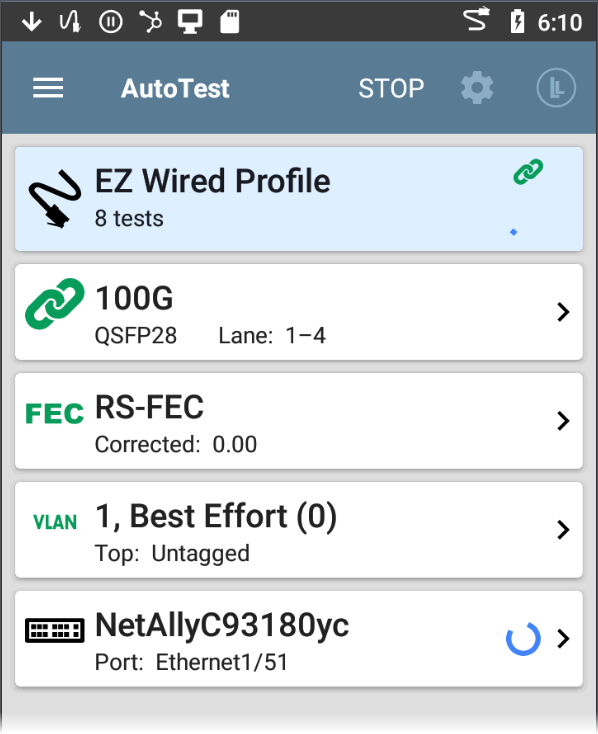
AutoTest establishes the link, identifies the connected switch and port, and tests the network services configured in the profile. Each test appears as a card on the results screen: link speed and lane configuration, FEC, VLAN, and the nearest switch.
Speed, Lane, and Forward Error Correction (FEC)
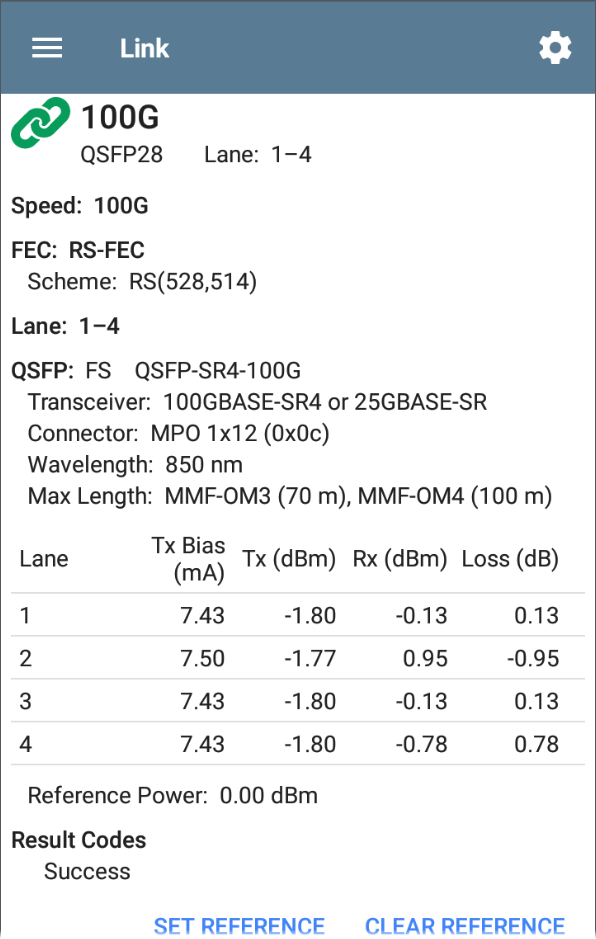
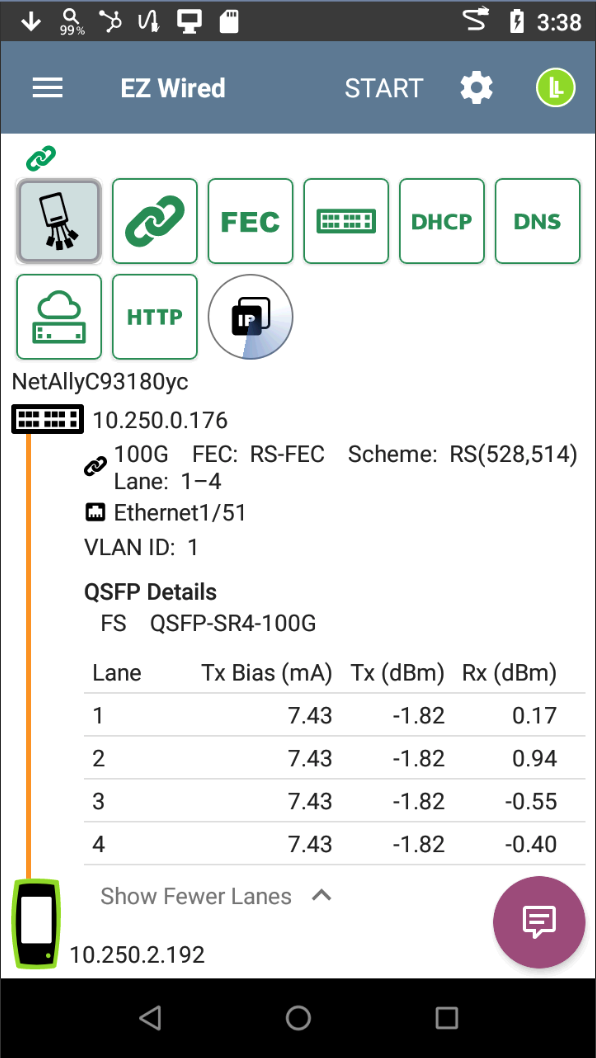
The Link details screen reports the configuration in use on the link: the speed, the FEC mode with its Reed-Solomon scheme, and the QSFP28 lanes carrying it.
Speed, QSFP Lane, and Forward Error Correction all default to Auto in a Wired AutoTest profile. On full Auto, the tester works out the configuration in front of it: it detects the highest speed the link supports, determines the appropriate lanes from the connected module, and applies the FEC mode the link is running. For most testing, no configuration is needed.
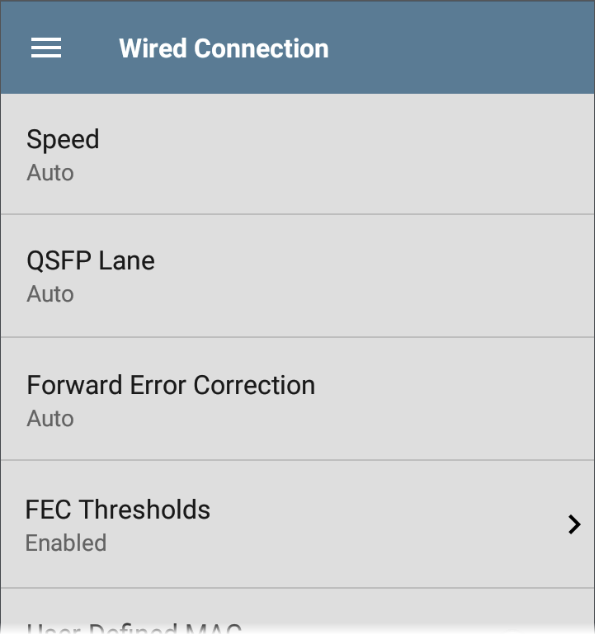
Specific settings are available when you want to test a particular configuration rather than accept what the link offers. Set a speed between 25 G and 100 G, select a single lane, a pair of adjacent lanes, or all four for breakout cabling, and choose a fixed FEC mode. Lane and FEC choices adjust to the selected speed and appear only when that speed supports them.
Forward Error Correction
Forward Error Correction is new for the LinkRunner 100G. FEC adds redundant data to the transmitted signal so the receiver can correct bit errors without requesting a retransmission. At 25 G per lane, a marginal connector or a mismatched FEC setting can degrade a link without incrementing the error counters on the switch, so AutoTest reports the FEC mode actually in use on the link.
FEC options are Auto, None, FC-FEC, and RS-FEC. Auto is the default and detects the FEC mode in use on the link. Link results report the mode in use, and an RS-FEC link also reports the Reed-Solomon scheme, such as RS(528,514).
FEC and Per-Lane Optical Results
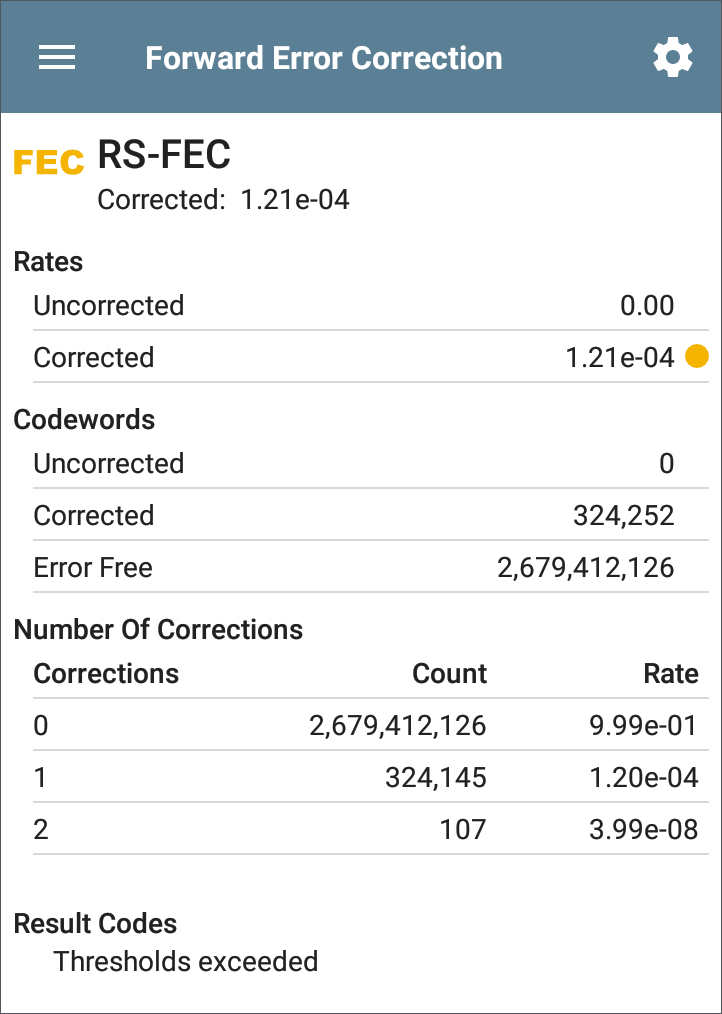
A FEC test card reports corrected and uncorrected codeword counts. Configurable warning and error thresholds grade the corrected rate; uncorrected errors always report as an error. The FEC card does not appear when FEC does not apply to the selected speed, when the FEC setting is None, or when the setting is Auto and the link comes up with no FEC.
The Link details screen displays the link speed, the FEC mode with its Reed-Solomon scheme, and the lanes carrying the link, followed by the installed QSFP module's vendor and part number, transceiver standard, connector type, wavelength, and maximum cable length per fiber type.
Below that, a per-lane table reports transmit bias current, transmit and receive power, and optical loss relative to a reference, so each lane can be checked individually. Touch SET REFERENCE to record the average Rx power of the active lanes as that baseline, or CLEAR REFERENCE to remove it. Result Codes at the bottom of the screen give the final status of the test.
EZ Wired Summary View
EZ Wired runs the same Wired AutoTest profile steps and presents them in a single scrolling view. Touch START to identify the nearest switch using LLDP, CDP, and EDP and pull its configuration, including the port name and VLAN assignment, alongside the link speed, the FEC mode, and the optical measurements reported by the installed module.
 QSFP Insights App
Examine the Installed Module and the Link It Supports
QSFP Insights is a new application, available only on the LinkRunner 100G. It reads the installed module and reports what it supports, across 25 G, 40 G, 50 G, and 100 G optics and including single-mode, multi-mode, trunk, LC breakout, and MTP/MPO cabling.
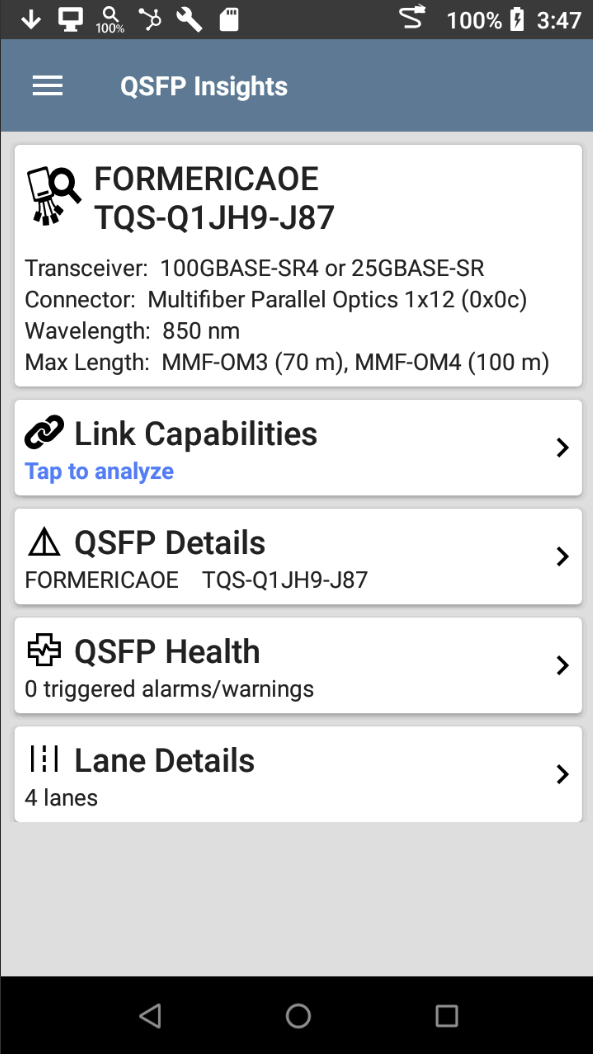
The home screen identifies the module as soon as you open the app, reporting vendor, part number, transceiver standard, connector type, wavelength, and maximum supported cable lengths. Four sections below provide deeper data:
-
Link Capabilities – Reports the speed, lane configuration, and FEC mode the installed module supports.
-
QSFP Details – Full module identification and specification data, including optical modulation, nominal bitrate, maximum length per fiber type, CDR status, and power class.
-
QSFP Health – Real-time measurements such as temperature and voltage, compared against the alarm and warning thresholds programmed into the module. An indicator on a threshold shows the measurement has crossed it at least once since the module was inserted, even when the current value is back in range.
-
Lane Details – Per-lane receive power, transmit power, and transmitter bias current, each against the module's own thresholds.
QSFP Health and Lane Details appear only when the installed module reports that data.
Connect Directly from Link Capabilities
Tap CONNECT on a Link Capabilities card to run a Wired AutoTest profile using the speed, lane, and FEC values the card reports. If a profile with those values already exists, AutoTest uses it. Otherwise the tester creates one, then opens and runs it.
NOTE: The Insights app requires an active AllyCare Pro subscription. See netally.com/allycare-support.
 Performance Testing to 100 Gbps
Line Rate Performance up to 100 Gbps
The Performance Test measures throughput, loss, latency, and jitter at line rates up to 100 Gbps, across a Layer 3 path between two endpoints.
Target Rate options are 10, 25, 40, 50, and 100 Gbps, along with the 99.98% equivalent of each, and a custom value you can enter yourself. Traffic flow, frame size, VLAN, and QoS are configurable, and the test can run below line rate to reduce disruption when troubleshooting an operational network.
Rates above 10 Gbps require a second LinkRunner 100G as the Source or Endpoint. An EtherScope nXG, LinkRunner 10G, or CyberScope endpoint limits the test to 10 Gbps.
QSFP28 Test Port
Testing Through the QSFP28 Port
The LinkRunner 100G tests through a QSFP28 port on the top of the unit, with a separate RJ-45 port for management. Establish link on the test port by running a Wired AutoTest profile.
The tester ships with an 850 nm multimode 100G QSFP28 dual-rate optical interface, a 3-meter multimode LC/LC fiber patch cable, 3-meter MPO12 Type A and Type B trunk cables, and a QSFP28-to-QSFP converter.
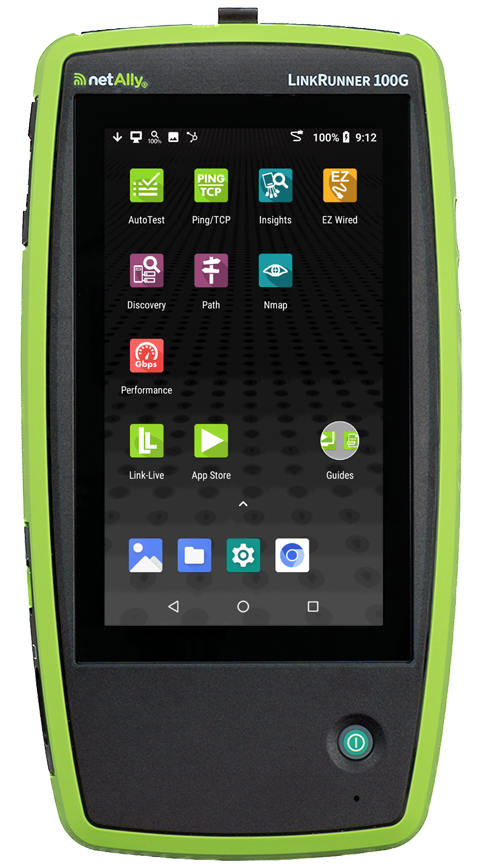
Applications available on the LinkRunner 100G are AutoTest, EZ Wired, QSFP Insights, Discovery, Path Analysis, Ping/TCP, Performance, Nmap, and Link-Live.
Updating Tester Software
This software update is a key benefit of your AllyCare™ Pro support contract. For more information about AllyCare benefits, see AllyCare Support · Customer Self-Service (netally.com).
Push the Update from Link-Live
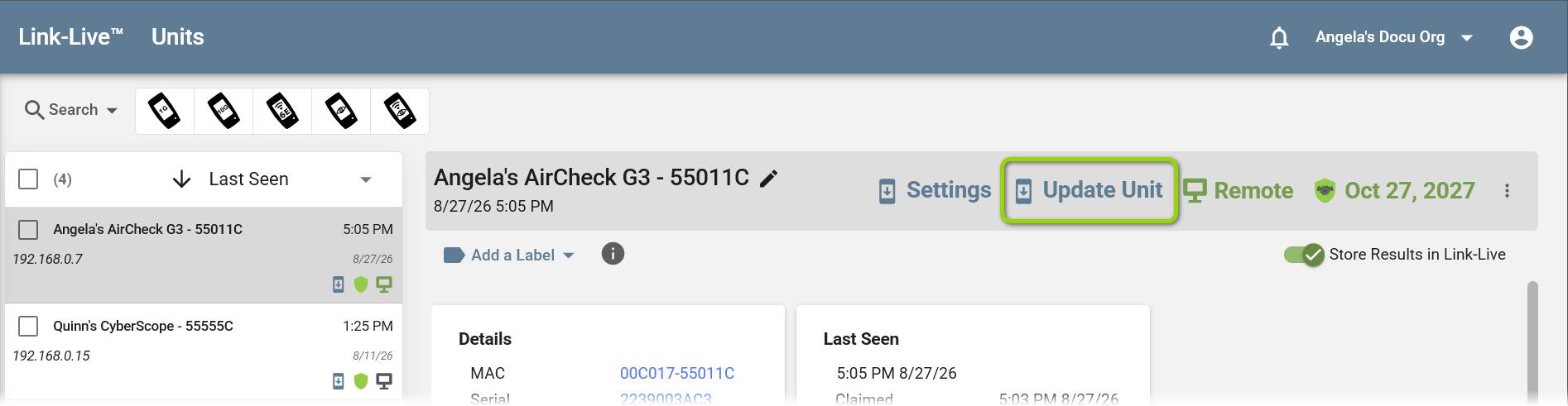
You can now update your testers from the Link-Live Cloud site. Visit the Units page for your Organization and click to highlight the unit you want to update. Above the details panel for the unit, select the Update Unit button. The unit will download the update and install, then restart. Updates are pushed one unit at a time.
Update from the Tester
You can also update over the air (OTA) on the unit itself. If the tester is claimed to Link-Live.com:
-
To check for available software updates at any time, open the
 Link-Live App from the Home screen.
 -
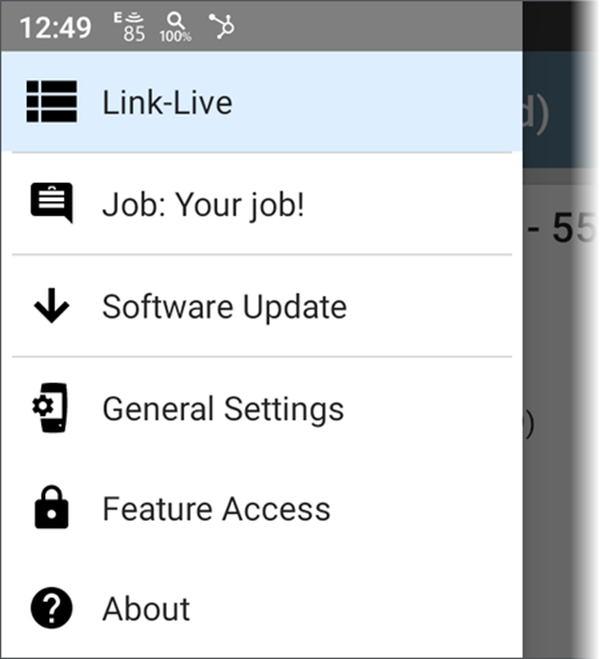
In the Link-Live App, touch the menu icon or swipe right to open the left-side Navigation Drawer.
-
Touch Software Update. The Software Update screen opens and displays the version number of any available updates.
-
Touch Download + Install to update the system.
When finished, the tester will restart.
Thank you for your investment in NetAlly products!