
As organizations grow and adopt AI workloads, real-time applications, and cloud-first architectures, network bandwidth requirements are rapidly outpacing 10G and 40G capabilities. This is why many modern data centers and enterprise networks are standardizing on 100G Ethernet (100GbE).
In this guide, we explore exactly what 100G Ethernet is, how it works, and why it’s necessary for scaling your infrastructure beyond 10G and 40G.
Table of Contents
What is 100G Ethernet?
100G Ethernet refers to standard Ethernet links which run at a data rate of 100 Gigabits per second (100Gbps). As a standards-based technology, 100G Ethernet utilizes Ethernet framing and data link protocols.
While 100GbE technology can be deployed in the backplane of a switch or router, this guide focuses on network links outside of the switch. 100G Ethernet links are found in the core, distribution and access layers of the network. 100GbE is also found in the data center, campus interconnect and access to internet services.
Most uses of 100G Ethernet demand a physical layer that is optical. Optical links are required to achieve the speed/distance combinations needed for most use cases.
100G Ethernet is a member of the IEEE 802.3 family of standards. Interoperability is ensured by adherence to the IEEE 802.3 standards and compliance with Multi-Source Agreement (MSA) specifications.
100G Ethernet Standards (IEEE 802.3) and Multi-Source Agreement (MSA) Specifications
The Institute of Electrical and Electronics Engineers (IEEE) first defined 100G Ethernet with the 802.3ba-2010 standard. A key update for data center and enterprise networking was the 802.3bm-2015 which defined the 4-lane architecture (4x25G) and compatibility with the QSFP28 transceiver. Multi-Source Agreements (MSAs) provide the framework and requirements for interoperability across vendors.
Key Attributes of 100G Ethernet Standards
Some important attributes of the 100G Ethernet standards which contribute to ease of upgrading are:
- Familiar and well understood: Utilizes the 802.3 Ethernet frame format, 802.3 Medium Access Control (MAC) protocol and the 802.3 standard minimum and maximum frame sizes.
- Flexible deployment options: Network links can operate over Single-Mode Fiber (SMF), Multi-Mode Fiber (MMF) type OM3 and OM4, and short reach copper cable assemblies.
- Reliable links over long distance: Forward Error Correction (FEC) technology provides acceptable Bit Error Rate (BER) to deliver line rate performance over long distances.
- Increasing reach: 100G Ethernet supports signaling (or encoding) using 4-level Pulse-Amplitude Modulation (PAM4). PAM4 allows for higher data rates and bi-directional operation in links up to 80km in length. PAM4 utilizes 4 levels allowing 2 data bits per symbol. This effectively doubles the data rate.
- Interoperability: The optical modules (also known as 100G transceivers) used for 100G Ethernet are compliant with the Quad Small Form-Factor Pluggable 28 (QSFP28) specification as defined by the MSA SFF-8665. The key goal is inter-vendor interoperability.
QSFP28 Transceivers and the 4-Lane Architecture
The QSFP28 interface provides for “4 lanes” of 25Gbps each to deliver an aggregate data rate of 100Gbps. The conversion of signals between electrical and optical occurs within the transceiver. The transceiver may also add FEC bits, change the encoding or multiply the speed when converting from electrical to optical. The QSFP28 transceiver is not necessarily a simple electrical/optical converter.
The data rate of 100Gbps is achieved by distributing the data across four “lanes” each running at 25Gbps. The 25G lanes may be implemented as physical fiber strands or different wavelengths of light within a strand.
Pro Tip:
When planning 100G deployments, don’t assume all QSFP28 transceivers are created equal. Pay attention to FEC requirements, power consumption, and whether your specific transceiver supports breakout configurations. These details can make or break your deployment.
100G Ethernet Fiber Types and Maximum Distances
The 100G reach distance possible is a function of the fiber type, Forward Error Correction, 100G signaling and characteristics of the 100G optical modules within the transceiver.
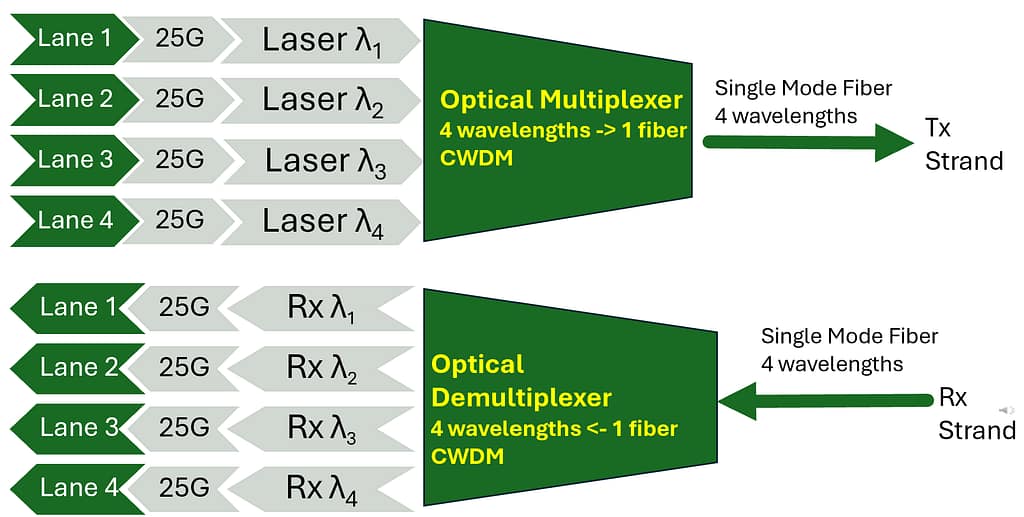
Single Mode Fiber with 4 lanes in a single strand for transmit and 4 lanes in a single strand for receive.
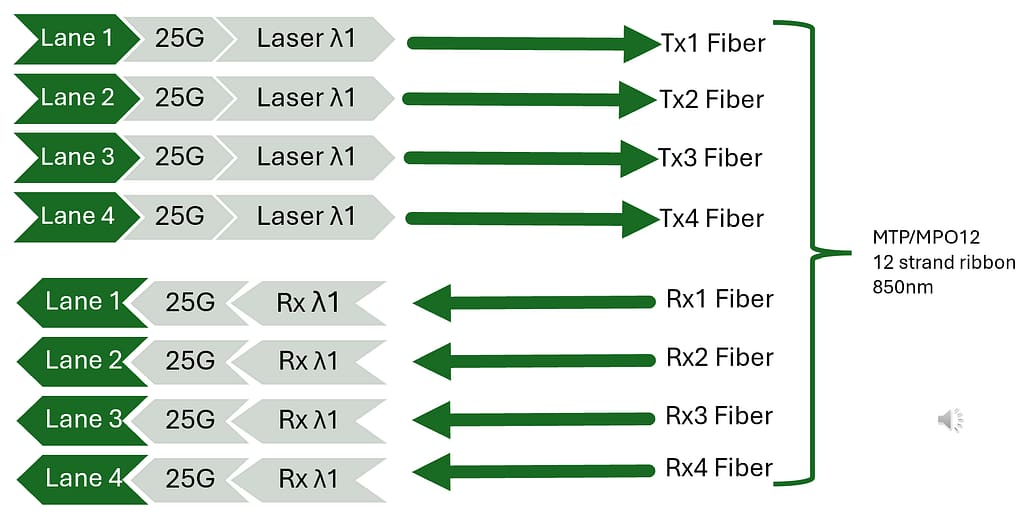
The table below presents a few of the common distances possible. You will notice a non-standard transceiver type. This is included because it is widely used by Cisco and serves an important need for optimizing fiber infrastructures (increasing the number of links for a given number of strands).
| Name | Standard | Media | Reach (m) |
| 100GBASE-SR4 | 802.3bm-2015 (Clause 95) | OM3 MMF OM4 MMF | 70 100 |
| 100GBASE-LR4 | 802.3ba-2010 (Clause 88) | OSx SMF | 10,000 |
| 100GBASE-SR2-BiDi | Proprietary (non IEEE) | OM3 MMF OM4 MMF OM5 MMF | 70 100 150 |
When to Upgrade: 100G over 10G/40G
For many organizations, the 100G upgrade from 10G or 40G to 100G Ethernet is no longer a technical luxury – it’s becoming a business necessity. The combination of higher bandwidth, operational efficiency, and future-proofing makes 100G the new baseline for modern data center networking and network architecture. Key business drivers include:
Rising Bandwidth Demands from Modern Workloads: The explosion of AI processing, high-resolution video, cloud traffic and real-time applications continue to push traffic volumes far beyond what 10G or 40G networks were designed to handle. The 100G vs 40G comparison is stark: moving to 100GbE delivers up to 10× more throughput, enabling organizations to support new digital services without performance bottlenecks.
Greater Cost Efficiency and Lower Operational Overhead: Consolidating multiple 10G or 40G links into a single 100G connection reduces:
- Power consumption
- Cabling complexity
- Rack space usage
- The number of interfaces to maintain
This directly improves OPEX while simplifying lifecycle management and troubleshooting.
Future-Ready Architecture for Long-Term Growth: 100G Ethernet provides the performance headroom needed to support the growing bandwidth needs of the organization. It also establishes a smooth, low-disruption path to next-generation speeds such as 200G and 400G, protecting today’s investments and avoiding premature hardware refresh cycles.
Deployment Flexibility for Evolving Infrastructure Needs: 100G links are built from four 25G lanes which can be configured as separate physical links operating as independent network interfaces. This allows a single QSFP28 module to support 25G links to 4 servers.
For organizations adopting 25G top of rack (TOR) switch architectures, this flexibility ensures that switching to 100G in the future requires no change in optics. In other words: long-term cost savings and operational simplicity.
Pro Tip:
If you’re deploying 25G server connections today, deploy 100G-capable infrastructure now. When you’re ready to upgrade to 100G server interfaces, you won’t need to swap out transceivers. Your future self will thank you.
Validate and Troubleshoot Your High-Speed Network
Understanding 100G Ethernet standards is one thing. Validating that your deployment actually works as designed? That’s where the real work begins.
When you’re deploying or troubleshooting 100G infrastructure, you need tools that can keep up with Multi-Gig speeds and provide instant visibility into what’s actually happening on your network. Network professionals using the right testing tools report 60% time saved resolving network issues and a 30% reduction in problem escalations.