
You are out of dark fiber. Pulling new cable is expensive, disruptive, and usually the last thing anyone wants to approve in a budget meeting. When it is time for a network upgrade, many engineers assume they have to rip out their existing LC cabling and replace it with high-density MPO or MTP connectors, or switch entirely to Single-mode fiber (SMF).
Bidirectional (BiDi) communication proves otherwise.
BiDi addresses the demand for increased network scale by sending and receiving data over a single fiber optic cable. These deployments save network resources, cut infrastructure costs, and allow you to maximize the cabling you already have in the walls.
This guide explains how bidirectional communication works in the 100G Ethernet standard to effectively double the density of your existing fiber strands.
Bidirectional Fiber: What are the Benefits for 100G Ethernet
Moving to 100GbE does not have to mean a complete infrastructure overhaul. Bidirectional fiber delivers multiple practical benefits to 100G Ethernet deployments:
- Reduction in capital expenditure: You can re-use your existing LC multimode fiber (MMF) infrastructure instead of buying new cables.
- Reduced operational costs: BiDi allows for a straightforward 25G/40G/50G/100G upgrade path from 10G and 40G BiDi without changing the physical fiber layout.
- Future-proofing: It eases the eventual transition to 400G Ethernet.
- Signal integrity: It reduces transmission errors by utilizing KP4-FEC (a Reed-Solomon based Forward Error Correction).
Bidirectional Fiber (BiDi): Ins & Outs of Optics
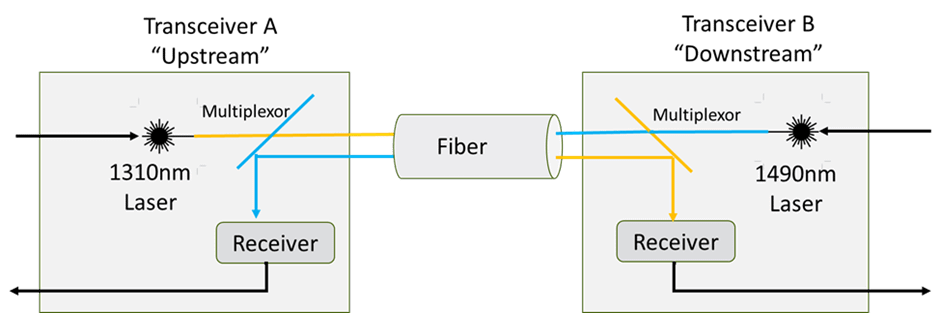
Standard fiber connections use two strands: one to transmit and one to receive. BiDi transceivers change the math by utilizing WDM (Wavelength Division Multiplexing).
WDM uses two different wavelengths of light to transmit two streams of information simultaneously on a single fiber strand. Figure 1 depicts a functional block diagram of a bidirectional system on a single strand. An optical module (or transceiver) with duplex LC connectors will have this system implemented on each strand, effectively giving you two independent bidirectional links on a standard duplex cable.
Pro Tip:
It is not possible to use standard laser light detectors to determine the polarity of a fiber optic cable with bi-directional transceivers. Because both strands are actively lit with transmit signals, traditional light detection methods will give you a false reading.
Bidirectional Fiber Explained: How BiDi Increases Efficiency
To understand the efficiency of BiDi, we have to look at how 100G is normally delivered.
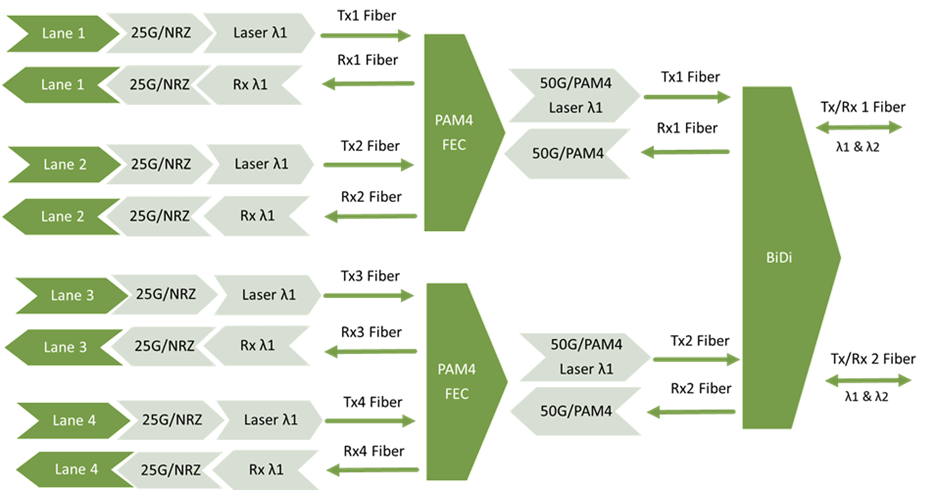
The 100G Ethernet standard achieves its data rates by using 4 lanes of 25G each. In typical MMF modules, 8 fibers are required to achieve bi-directional communication (4 Tx and 4 Rx). This is why the industry often pushes 8-fiber or 12-fiber MPO connectors for high-speed links.
Bi-directional optical modules take a smarter approach. They integrate the four electrical lanes into two 50G optical lanes on a standard 2-fiber duplex LC multi-mode fiber. They achieve this density using PAM4 encoding. The overall effect is a massive reduction in required infrastructure: from 8 fibers down to 2.
While SMF is often required for long-haul connections, MMF remains the workhorse of the data center. BiDi allows that MMF workhorse to carry significantly more weight.
FAQ
What is a BiDi transceiver?
A BiDi (bidirectional) transceiver is an optical module (commonly a QSFP28) that uses a single strand of fiber for 100G Ethernet communications. The transmit and receive signals are encoded on different wavelengths multiplexed on the single fiber.
What is the difference between BiDi and traditional duplex 100G Ethernet?
Standard duplex uses two fibers (one dedicated to transmit and one dedicated to receive). BiDi uses Wavelength Division Multiplexing (WDM) to combine the signals in both directions onto a single fiber strand.
Does BiDi work on existing 40G cabling?
Yes, BiDi works on existing duplex LC fiber infrastructures, easing the ability to upgrade to 100G from 40G without pulling new cable.
Does BiDi work with Multimode Fiber (MMF)?
Yes, there are specific modules such as 100G_SRBD which are designed for multimode fiber (OM3, OM4, OM5) with maximum distances ranging from 70m to 150m.
Does BiDi require FEC (Forward Error Correction)?
Yes. Because PAM4 encoding crams more data into the signal, it has a lower margin for signal integrity. FEC provides an acceptable error rate for PAM4 transmissions by cleaning up the signal before it is processed.