
The world of fiber optics is an alphabet soup of acronyms and a rainbow of jacket colors. But a fiber link only delivers reliable performance when built on a solid infrastructure. Whether you are planning a 25G/40G/50G/100G upgrade or maintaining existing networks, understanding the physical layer is non-negotiable.
This guide breaks down the key components and attributes of the dark fiber infrastructure so you can make the right call when selecting cables, connectors, and transceivers.
Dark Fiber Infrastructure – Overview of the Components
The dark fiber infrastructure refers to the passive components that deliver optical signals from one end of a fiber run to another. These runs can stretch up to 80km.
Maintaining a high-performing system from the transmitters to the receivers with no amplifiers along the path is a significant technical challenge. Every connection point, transceiver, and component degrades the optical signal slightly. These components must be carefully selected for compatibility and consistency across various parameters, including fiber patch cable connectors, fiber type, polish type, polarity, and overall length.
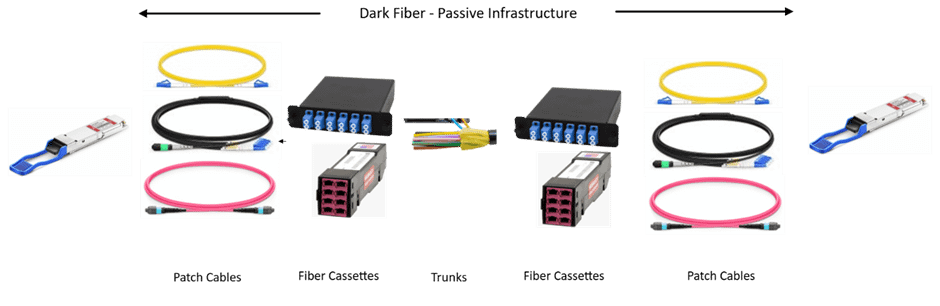
Fiber Cable Types & Connectors: Acronyms Decoded
Fiber optic patch cables consist of the connectors on the ends of the fiber cable. The options on these cables dictate the fiber type, connector type, polarity, and polish type.
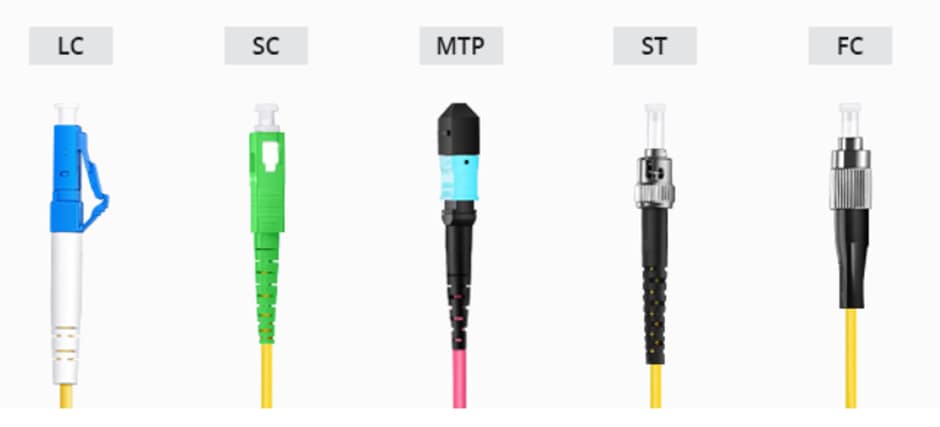
The fiber types are SMF (Single-mode fiber) and MMF (multimode fiber). The most common connector types are LC, SC, MTP/MPO, ST, and FC. Polarity defines how the fiber strands are routed from one end to the other for duplex and multiple strand cables. The polish types are PC, UPC, and APC.
Figure 2 presents a quick reference guide for the most common acronyms.
| Acronym | Meaning | Context |
| APC | Angled Physical Contact Connector | The polish style of the fiber endface. |
| FC | Ferrule Connector | A type of connector on the fiber cable. |
| LC | Lucent Connector | A type of connector on the fiber cable. |
| MMF | Multi-Mode Fiber | A type of fiber. |
| MTP/MPO | Multi-fiber Push-On | A type of connector on the fiber cable. |
| OM3 | Optical Multi-Mode Fiber type 3 | A type of multi-mode fiber. |
| OM4 | Optical Multi-Mode Fiber type 4 | A type of multi-mode fiber. |
| OM5 | Optical Multi-Mode Fiber type 5 | A type of multi-mode fiber. |
| OS1 | Optical Single Mode fiber type 1 | A type of Single-mode fiber. |
| OS2 | Optical Single Mode fiber type 2 | A type of Single-mode fiber. |
| PC | Physical Contact Connector | A type of connector on a fiber cable. |
| SMF | Single-Mode Fiber | A type of fiber. |
| ST | Straight Tip | A type of connector on a fiber cable. |
| UPC | Ultra Physical Contact Connector | A polish style of the fiber endface. |
Single-Mode vs Multimode: Decoding Fiber Cable Types, Colors & Connectors
The fiber cable type dictates the maximum overall length of the optical path. There are two major types with sub-types, color-coded for visual identification. Table 1 presents the fiber types available for the 100G Ethernet standard.
| Fiber type | Sub-type | Jacket Color | Maximum length | Cable Colors |
| Multi-mode (MMF) | OM3, OM4, OM5 | Aqua, Aqua, Green | 100m, 150m, 300m | |
| Single-mode (SMF) | OS1/OS2 | Yellow | 80km |
There are five commonly used fiber optic connectors. Figure 3 depicts these connectors.
| Type | Name | Key features & applications |
| LC | Lucent Connector | Small footprint makes them ideal for high-density applications. The most commonly used presently. |
| SC | Square Connector | First connector standardized for TIA-568. Twice the size of the LC. |
| MTP/MPO | Multifiber Termination Push-on | A multi-fiber connector combines 12 to 24 fibers into one connector (like the MPO12). Usage is complicated by key-up/key-down and polarity issues. |
| ST | Straight-Tip | Created by AT&T to provide a secure connection with a half-twist bayonet mount. |
| FC | Ferrule Connector | A screw-type fitting made from stainless steel. Used in precision instruments. |
Polish Types
The polish type defines the physical shape of the fiber face. It has a profound impact on the performance of the connection. Polish types have improved greatly over time to meet higher performance requirements. 100GbE is supported by two of the three polish types. The color of the connector body indicates the polish type.
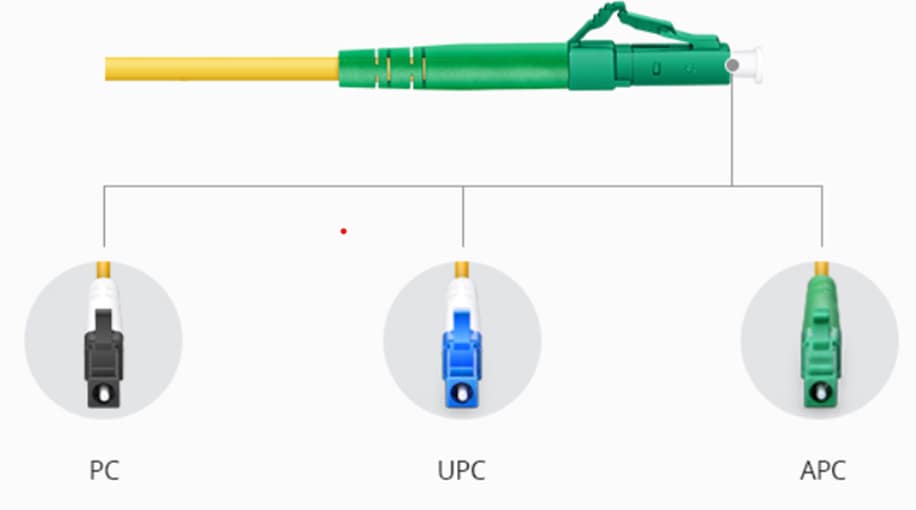
Polish types have evolved with subsequent performance increases. Table 2 describes each polish type.
| Type | Name | Key features & applications |
| PC | Physical Contact Connector | Eliminates the air gap between the two surfaces. Most common on OM1 and OM2 fiber. Not used for 100G Ethernet. |
| UPC | Ultra Physical Contact Connector | Improved performance over PC. Repeated connections and disconnections degrade the surface and the performance. |
| APC | Angled Physical Contact Connector | The highest performance polish. The end face is polished at an angle minimizing reflections and leaked light. |
Pro Tip:
APC connectors should only be mated with other APC connectors. Mating an APC with a UPC causes very high insertion loss and may permanently damage the fiber end face. This is a costly mistake if the damaged fiber end face is inside an expensive optical module.
A Practical Guide to Fiber Cables & Connector Types for 100G Networks
In practice, the choices for your fiber infrastructure are straightforward. The specific use case drives the design.
SMF or MMF?
The first question is about which type of fiber to use. Two common use cases for 100G Ethernet are:
- Intra-data center: MMF (multimode fiber) – MMF supports typical distances within a data center connecting switches and servers. This is not surprising since data centers were likely built on copper, twisted pair Ethernet standards that have a maximum length of 100m.
- Inter-data center: SMF (Single-mode fiber) – SMF supports the distances found for campus interconnect and metropolitan area connections.
Duplex or Multi-strand cables?
A multi-strand cable with an MPO connector works well for:
- Consolidating multiple fibers in backbone cabling where space is limited.
- Supporting parallel optics inherent in 100G Ethernet (100GBASE-SR4, 100GBASE-LR4).
- Breakout connections, where the 100G link is used as four 25G links.
LC or SC connectors?
LC fiber connectors are best for high-density data center applications because they maximize physical port density. The compact design of the LC connector allows for twice as many connections in a given space compared to SC connections. SC fiber connectors are best when durability is a higher priority than density.
UPC or APC polish type?
UPC is for data center applications where a low-cost solution is needed. APC is needed for high-performance, long-haul telecom applications such as DWDM (Dense Wave Division Multiplexing).
General Guidelines
Consistency is your friend for a reliable fiber optic system.
- Do not mix SMF and MMF.
- Do not mix OM3, OM4, OM5 – pick one.
- Do not inter-connect APC and UPC.
- Pay careful attention to the polarity strategy end to end – only one flip in polarity is needed.
FAQ
How do I decide what cable type to use?
The most important requirement is the maximum length of the fiber run. Once that is established, you can decide whether you must use SMF or can use MMF. From there, other requirements shape your decision, such as the network upgrade roadmap of your organization, existing infrastructure, and budget.
What cable type is needed for 100G?
100G Ethernet can utilize either SMF or MMF (OM3, OM4, and OM5).
How far does 100G reach over fiber?
The reach depends on the fiber type. Multi-mode fibers have a maximum reach up to 300m, while Single-mode fibers have a maximum reach of up to 80km.